Image unavailable
Image unavailable
Rosemount
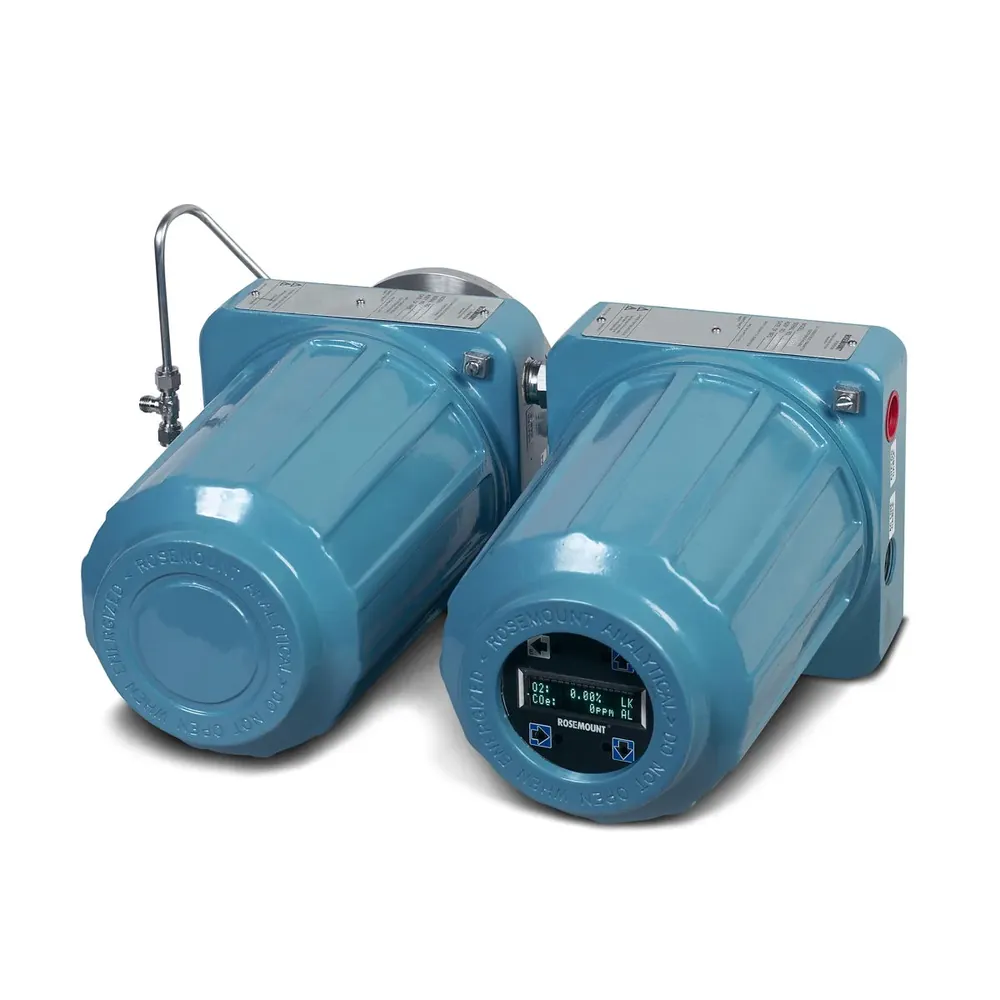
Rosemount OCX8800 Oxygen Transmitter
Quote on request
No online payment · add lines to RFQ BOM
In-situ O2 + COe flue-gas transmitter. HART/FF; auto-cal options. RFQ + selection help.
Download datasheet PDF
RFQ cart holds BOM lines only. Submit for engineering quote.
Key parameters
Ambient temperature
Sensor housing –40 to +212 °F; electronics –40 to +149 °F
Communication
HART (H1–H4 options) or FOUNDATION Fieldbus; AMS/PlantWeb compatible
O2 Range
Net O2 0–1% to 0–40%, field-selectable via HART or LOI
Combustibles Range
0–1000 ppm to 0–5%, field-selectable via HART or LOI
Accuracy O2
±0.75% of reading or 0.05% O2, whichever is greater
Accuracy Combustibles
±50 ppm
Fits combustion flue-gas control where you need a Rosemount OCX8800 in-situ zirconia O2 plus catalytic-bead combustibles (COe) transmitter with HART or FOUNDATION Fieldbus.
Key advantages
- O2 + combustibles — Oxygen and combustibles transmitter for flue gas
- O2 range — 0–1% to 0–40% O2 (configurable class)
- Accuracy — O2 ±0.75% of reading or ±0.05% O2 (greater)
- Sensors — Zirconia O2 with catalytic platinized beads; catalytic-bead COe with dilution air
- Electronics — HART or FOUNDATION Fieldbus; optional LOI; integral or remote electronics; auto-calibration options
Typical applications
- Boiler and fired-heater excess-O2 trim with combustibles cross-check.
- Flue-gas O2/COe where process temperatures require the OCX8800 probe class.
- Sites needing HART/FF diagnostics and auto-calibration sequencing.
Selection guide
- Probe length / material — per OCX88A order code
- Communications — HART vs FOUNDATION Fieldbus
- Electronics mount — integral vs remote; LOI yes/no
- Auto-calibration — with or without sequencer accessories
Common mistakes
- Treating OCX8800 as O2-only — COe combustibles sensing is part of the published function set.
- Ignoring heater/probe voltage and probe length on the order string.
- Assuming auto-calibration hardware is included without the sequencer option.
When to RFQ / what to tell us
- Flue application, probe length/material, and O2/COe spans.
- HART vs Fieldbus; integral vs remote electronics.
- Auto-cal / LOI needs; hazardous-area; quantity; ship-to.
Request a Quote · Get selection help
Specs
| Spec | Value |
|---|---|
| SKU | 1207-0001 |
| Brand | Rosemount |
| Model | OCX8800 Oxygen Transmitter |
| Product type | Oxygen / Combustibles Transmitter |
| O2 range | 0–1% to 0–40% O2 |
| Medium | Flue gas |
| Accuracy | O2 ±0.75% of reading or ±0.05% O2 (greater) |
| Features | Oxygen and combustibles (COe) transmitter; zirconia O2 + catalytic-bead COe; HART or FOUNDATION Fieldbus; optional LOI; integral/remote electronics; auto-calibration options |
Documents
FAQ
Q: What does OCX8800 measure? A: Continuous flue-gas oxygen and combustibles equivalent (COe).
Q: What O2 accuracy is published? A: ±0.75% of reading or ±0.05% O2, whichever is greater.
Q: What should I send for a quote? A: Probe length, protocol, electronics mount, auto-cal needs, quantity, ship-to.
Links
| Parameter | Value |
|---|---|
| Ambient temperature | Sensor housing –40 to +212 °F; electronics –40 to +149 °F |
| Communication | HART (H1–H4 options) or FOUNDATION Fieldbus; AMS/PlantWeb compatible |
| O2 Range | Net O2 0–1% to 0–40%, field-selectable via HART or LOI |
| Combustibles Range | 0–1000 ppm to 0–5%, field-selectable via HART or LOI |
| Accuracy O2 | ±0.75% of reading or 0.05% O2, whichever is greater |
| Accuracy Combustibles | ±50 ppm |
| Response Time | O2 10 s T90; combustibles 25 s T90 to test gas |
| Sensor Technology | Zirconia oxygen cell + catalytic bead combustibles (COe) |
| Process Temperature | 316L SS probe to 1300 °F (704 °C); Alloy 600 to 1832 °F (1000 °C); ceramic to 2600 °F (1427 °C) |
| Enclosure | NEMA 4X, IP66 compact housings; explosion-proof OCX88C variants |
| Calibration | Semi-automatic or automatic; optional factory auto-calibration panel |
| Reference Air | 2 scfh (1 L/min) clean dry instrument air at 35 psig (2.4 barg) |
| Probe Lengths | 18 in to 9 ft (457 mm to 2.7 m) depending on material |
| Special Features | Field-replaceable sensors; air purge cycle; internal/in-situ filters; optional blowback |