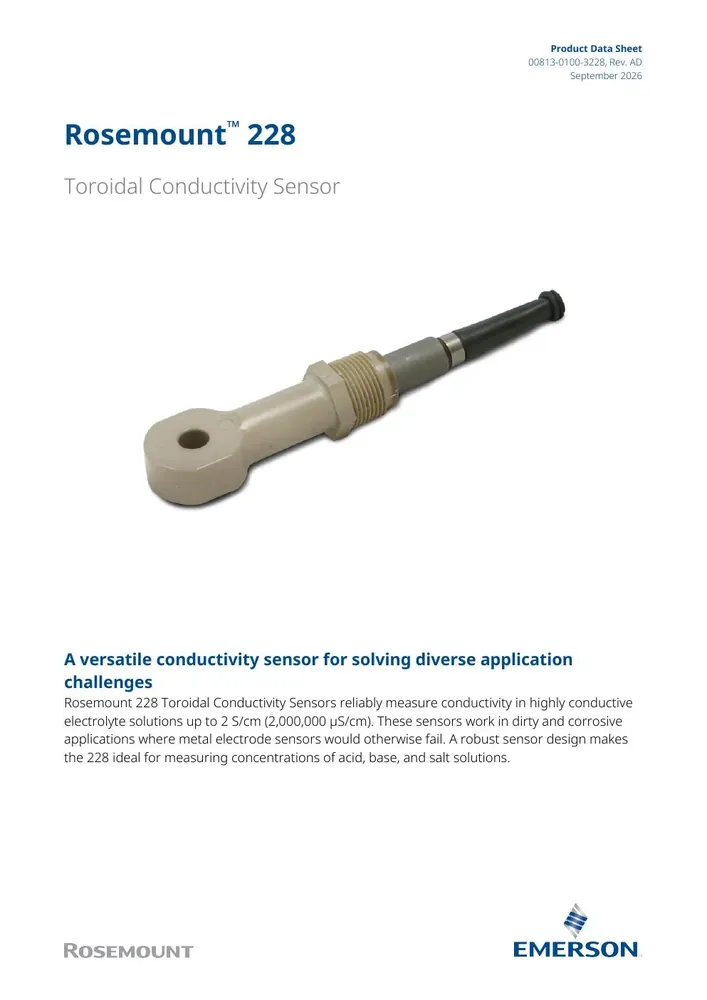
Image unavailable
Image unavailable
Rosemount
Rosemount 228 Toroidal Conductivity Sensor
Quote on request
No online payment · add lines to RFQ BOM
228: to 2 S/cm; PEEK/Tefzel; Pt-100; ¾ NPT or UNC; to 200 °C. RFQ.
Download datasheet PDF
RFQ cart holds BOM lines only. Submit for engineering quote.
Key parameters
Measuring range
Toroidal conductivity up to 2 S/cm (2,000,000 µS/cm) in highly conductive / dirty / corrosive solutions
Accuracy
Nominal cell constant 2.7/cm (PDS lists ~3/cm); field calibration required; wall-effect clearance ≥1 in from metal walls
Process connection
⅝-11 UNC (EPDM gasket; requires adapter) or ¾ in MNPT
Wetted parts
Glass-filled PEEK, glass-filled Tefzel®, or unfilled Tefzel body options
Sensor type
Toroidal (inductive) insertion/submersion conductivity sensor with integral PT-100 RTD
Notes
Specs from Emerson Rosemount 228 PDS 00813-0100-3228 Rev AD + QSG 00825-0100-3228.
Fits high-conductivity and dirty/corrosive liquid analysis where you need a Rosemount 228—toroidal sensor to 2 S/cm (2,000,000 µS/cm) with PEEK or Tefzel bodies, integral Pt-100, and insertion/submersion mounting.
Key advantages
- Range — Up to 2 S/cm
- Cell — Nominal ~2.7/cm
- Body — Glass-filled PEEK or Tefzel options
- T / P — Standard to 120 °C; high-T PEEK to 200 °C; to 295 psig (PEEK)
- Mount — ¾ in MNPT or ⅝-11 UNC; integral cable
Typical applications
- Acid / base / salt concentration.
- Dirty conductive process streams.
- Insertion or submersion conductivity.
Selection guide
- PEEK vs Tefzel
- Standard vs high-T
- Cable length / EMI shield
Common mistakes
- Metal-wall proximity causing wall-effect error.
- Using contacting electrodes instead of toroidal in fouling service.
- Wrong transmitter pairing.
When to RFQ / what to tell us
- Body/mount/cable.
- Transmitter, quantity, ship-to.
Request a Quote · Get selection help
Specs
| Spec | Value |
|---|---|
| SKU | 36300 |
| Brand | Rosemount |
| Model | 228 |
| Product type | Toroidal Conductivity Sensor |
| Type | Toroidal conductivity sensor (Rosemount 228) |
| Range | Up to 2 S/cm (2,000,000 µS/cm) |
| Cell constant | Nominal ~2.7/cm |
| Body | Glass-filled PEEK or Tefzel options |
| Temperature | Standard to 120 °C; high-T PEEK to 200 °C |
| Pressure | To 295 psig (PEEK options) |
| Connection | ¾ in MNPT or ⅝-11 UNC |
| RTD | Integral Pt-100; integral cable (20 ft standard class) |
Documents
FAQ
Q: Max conductivity? A: Up to 2 S/cm.
Q: Cell constant? A: Nominal about 2.7/cm.
Q: What should I send for a quote? A: Body/mount/cable, quantity, ship-to.
Links
| Parameter | Value |
|---|---|
| Measuring range | Toroidal conductivity up to 2 S/cm (2,000,000 µS/cm) in highly conductive / dirty / corrosive solutions |
| Accuracy | Nominal cell constant 2.7/cm (PDS lists ~3/cm); field calibration required; wall-effect clearance ≥1 in from metal walls |
| Process connection | ⅝-11 UNC (EPDM gasket; requires adapter) or ¾ in MNPT |
| Wetted parts | Glass-filled PEEK, glass-filled Tefzel®, or unfilled Tefzel body options |
| Sensor type | Toroidal (inductive) insertion/submersion conductivity sensor with integral PT-100 RTD |
| Notes | Specs from Emerson Rosemount 228 PDS 00813-0100-3228 Rev AD + QSG 00825-0100-3228. |
| Process Temperature | Standard up to 120 °C (248 °F); high-temp PEEK option up to 200 °C (392 °F) |
| Process Pressure | Up to 295 psig (21.4 bar) on high-temperature option |
| Cable | Integral cable options 10–100 ft; unshielded (54) or shielded EMI/RFI (56); 20 ft (6.1 m) common |
| Special Features | Reinforced internal metal frame for vibration; optional retraction assembly for hot insertion/removal |
| Compatible Transmitters | Recommended with 1056 / 1066-T / 56 / 5081 (shielded cable); also 1054/2054 with unshielded |